For those of you who are
new to all of this, here’s an acoustic primer
to help you get started.
Let’s take a look at what sound does inside
your room.
Low frequency sounds tend to spread out
and permeate the room. When the wavelength
of a sound is the same as a room dimension
a room mode will occur (when the volume
is high enough to excite it)...and this
will happen when you play or listen to your
music.
This is due to the natural resonance of
the room itself. These effects are called
“Room Modes.”
There are 3 types of room modes, Axial,
Tangential and Oblique.
Axial Modes |
Axial modes are based
on the length, width and height of your
room. |
Tangential Modes |
Tangential modes are
based on the dimensions of 4 room surfaces. |
Oblique Modes |
Oblique modes are
based on the dimensions of all 6 room
surfaces. |
Room modes create a series of peaks and
dips throughout the room, areas where the
volume is actually higher or lower than
that coming out of the speakers. The sound
pressure caused by room modes is greater
at walls, greater yet at dihedral corners
(where walls meet walls – ceilings and floors)
and greatest yet at trihedral corners (wall/wall/ceilings
or walls/walls/floors).
Obviously if you are mixing and happen
to be sitting in an area where there is
a dip – you will add more bass to the mix
to get it to sound right to your ears, but
when you play it back outside of your mixing
room you will find the mix to be bottom
heavy – too muddy with bass.
By the same token – if you mix where there
is a peak – you will add less bass (to balance
things out) and find the mix to be light
in the bottom end (too thin) when you listen
to your recording outside of your room..
In order to fix things, so you can create
a mix that translates well into other environments,
you either have to treat your room to lessen
the effect that these room modes have in
your listening environment, or, you have
to learn what your room is doing so your
mixes translate well in the real world.
Yes – you can learn to compensate – but
it isn’t fun – it’s a lot of hard work,
and if you are doing this with enjoyment
being a part of the equation – you’ll be
much better off if you fix your room.
Back to Top
DIFFERENT TYPES
OF TREATMENTS
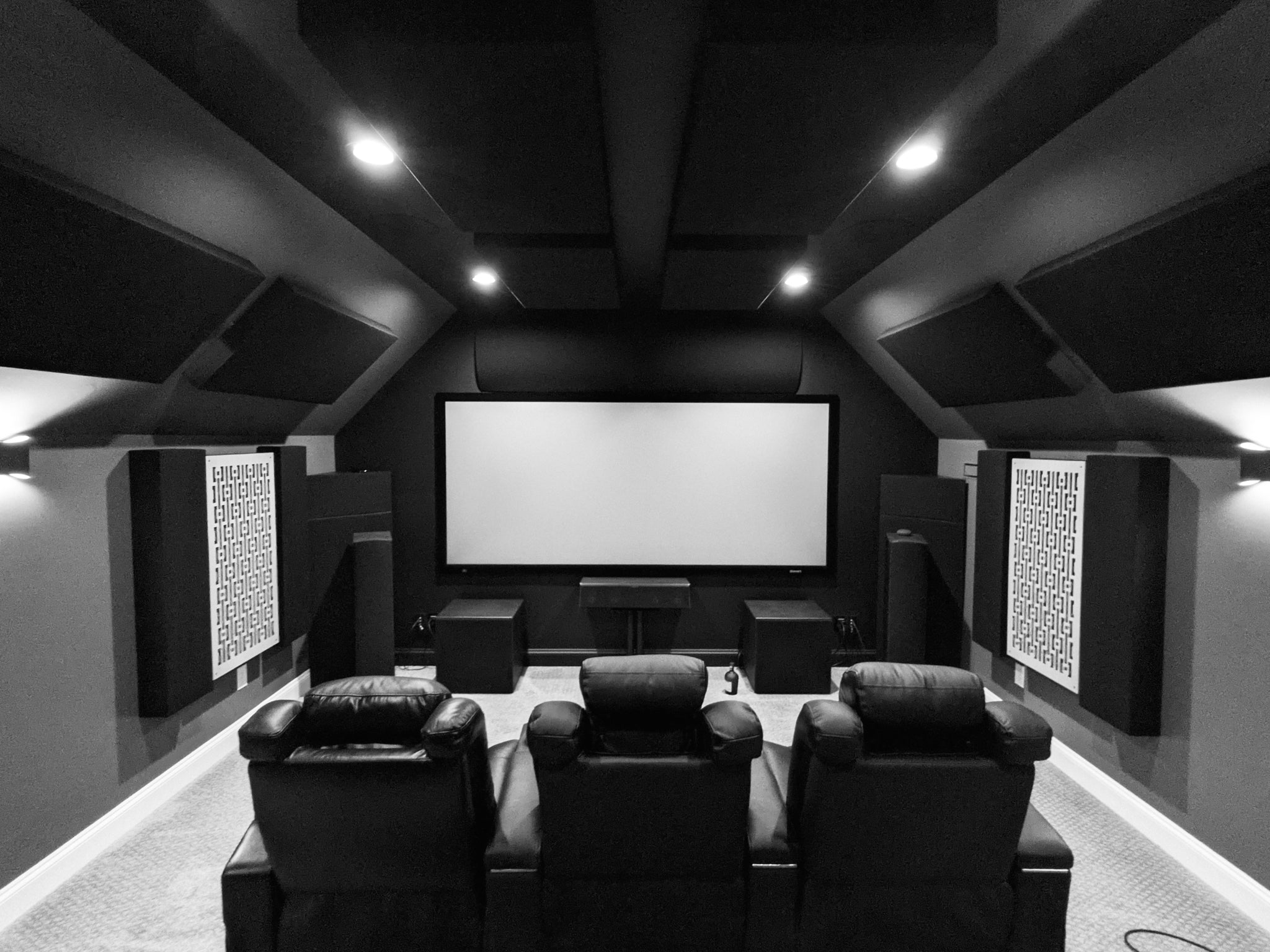
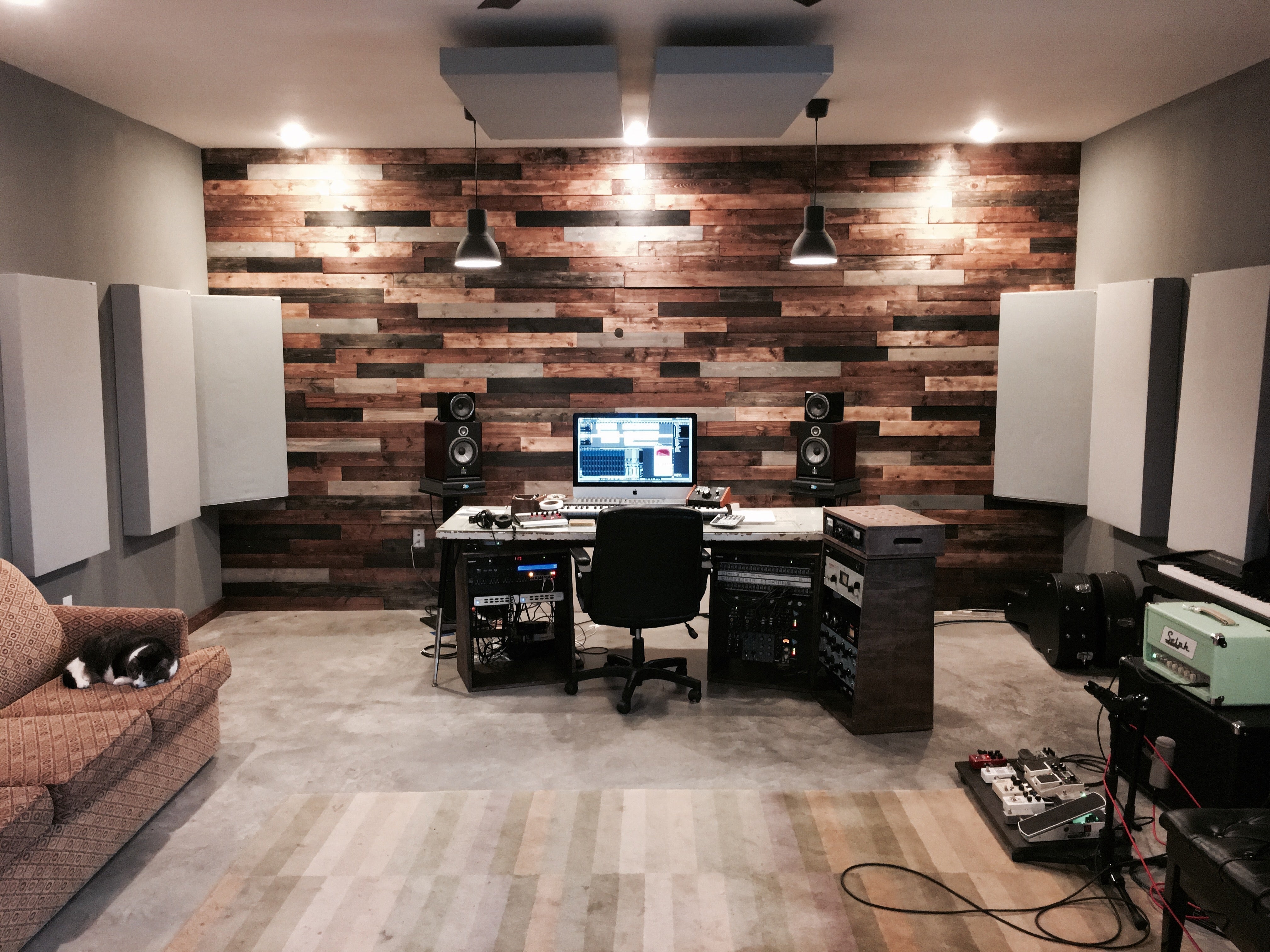
There are quite a few different
tools you can use for treating a room. Let’s
take a look at some of the more common methods.
a) Diffusors – these work on the principle
of modifying the location and movement of
sound in the space in relation to itself
and other frequencies.
Cylindrical diffusors work simply by splaying
a sound so that it doesn’t reflect back
onto itself in full intensity.
Skyline Diffusor |
Skyline diffusors
work on the same basic principle as
cylindrical diffusors. |
| Well-type
QRD’s (Quadratic Residue Diffusors)
modify the location of various waves
in relation to the room through the
use of “wells” with different depths. |
Quadratic Residue Diffusor
|
b) Rigid Fiberglass and Rockwool, Bass
thru High Frequency Absorbers
Treatments constructed from Rigid Fiberglass
and Rockwool are broadband in nature – thus
they tend to deal with the entire frequency
range. They are a very cost effective manner
in which to treat a room. Lean towards densities
of 3pcf (pounds per cubic foot) for higher
and mid frequencies – and 6pcf to tame more
of the low frequencies.
Placement of these traps with an air space
between them and the adjacent surface increases
the trap’s effectiveness. In the higher
density materials – these can be very effective
at low frequencies if placed straddling
dihedral and trihedral corners.
These traps work on the principle of sound
energy being converted into heat as the
sound passes through the insulating material.
c) Narrow Bandwidth Bass traps
Panel and Helmholtz bass traps deal with
low frequencies in a fairly narrow bandwidth
range. Thus these traps are usually the
last resort, used specifically to deal with
a problem frequency left in a room, after
broadband applications are in place.
Panel traps are constructed as sealed chambers
– and require that “air-tight” construction
in order to operate properly. Should you
lose the seal over time – you also lose
the effectiveness of the trap. A panel trap
can be constructed to effectively deal with
about an octave (1/2 above and below the
traps center frequency) by installing rigid
fiberglass behind (but not touching) the
back of the panel. If this material were
to touch the panel – it would not be allowed
to vibrate freely – and thus would fail
at it’s primary task.
Helmholtz traps as constructed with slats
of wood placed over framing members. The
frequency that these traps can handle is
determined by the depth of the trap, the
width and thickness of the slat and the
slot left between adjacent slats(the slot).
With a deep depth behind the slats – and
very small slots – these can be constructed
to handle very low frequencies.
Again, the placement of rigid glass materials
behind the slats helps to trap about an
octave around the center frequency of the
trap itself.
A Helmholtz trap can be constructed as
a broadband trap if it is designed as a
splayed trap – as well as through the use
of varying the slot widths in a flat trap.
Back to Top
PLANS
AND CALCULATIONS
You can find plans for these traps all
over the internet. Calculators for these
traps are available at www.rodssoundsolutions.com.
Just look on the “Outside The Box” page.
Back to Top
HOW TO TEST
YOUR ROOM
There are quite a few good programs out
there for room testing, I happen to like
a product called EFT by a company called
Acoustisoft.
They do have a demo version that you can
download, but I highly recommend purchasing
the entire package for the additional bells
and whistles you get with it.
Testing isn’t all that difficult – and
their documentation is pretty good – so
we won’t waste a whole lot of time explaining
to you exactly how to use the software………
but what is important is that you understand
the importance of performing lots and lots
of tests.
First you want to understand how to set
up your speaker and seating positions. Please
check out the instructions from your speaker
manufacturer, and then use the charts provided
here to fine tune your set-up.
Then you want to take a lot of test samples
in the area of your seating to figure out
what location has the flattest response.
It isn’t going to do you any good to just
take one test sample and go from there.
For each position (of the microphone) I
would suggest you take at least 10 readings,
which you can then overlay with one another,
The consistent readings (the ones that overlay
perfectly – or very close to perfectly)
are the correct ones for your location.
The ones that don’t match have some anomaly
that crept in and tainted the test data.
This does occur and is one of the reasons
that you really need more than one test
in each location.
When moving the microphone think in terms
of inches – preferably 1” at a time.
This is not a process you want to rush.
Heck – I know you want to get set up and
start recording – but taking your time during
the testing phase will pay dividends for
you in the long run.
What you are going to see in results will
depend a lot on your room – but you will
definitely see evidence of room modes –
as well as higher frequency activity having
to do with reflected sounds.
When you locate the spot that gives you
the flattest room response – that is where
you want your ears to be.
At this time – I would suggest that you
fine tune the location by first readjusting
your speakers to come back to a perfect
equilateral triangle – with the point ending
about 1’-4” behind the final microphone
placement. This will assure that your stereo
image works properly. Next – retest and
then fine tune with movements (of the microphone)
in increments of ¼”. Then do a final
re-set of your speakers.
Be careful when setting up your speakers
to make certain that the tweeters are the
same elevation as your ears. Check out the
following page for speaker layout.
Back to Top
PROPER SPEAKER
PLACEMENT
Standard Speaker Layout for
2 Channel Stereo |
Stereo
Speakers are typically placed in an
equilateral triangle.
This assures proper
stereo imagery.
|

Standard Speaker Layout for
5 Channel Surround |
Surround Systems
begin with the same set-up for the
front left and right speakers. The
remaining speakers should be placed
the same distance as the primary speakers
and angled as shown.
|
Back to Top
THE 38% RULE/ROOM
SETUP (2 CHANNEL AND SURROUND SOUND)
| A rule
of thumb for locating your listening
position is to place your head centered
left to right within your space, and
to back away from the front wall until
you are 38% of the room depth. |
You then want to place your speaker
so they are in the configuration
shown above – with the triangle
closing about 1’-4” behind the center
of your head.
Note, this is as shown in the sketch
on the right.
Begin any testing you will do with
the mic in the position indicated,
and then move the mic forward in
small increments towards the actual
listening position.
What you’re searching for is the
point where you have the flattest
response of all frequencies.
Understand that the flattest does
not mean you won’t exhibit peaks
and dips in response, just the best
listening location prior to room
treatments.
|

Treatment Placement |
Where you place room treatments really isn’t
all that difficult to figure out. Begin with
your room corners and work from there.
In the room corners you want to place Bass
Traps, preferably straddling the corners –
running from floor to ceiling if possible.
The reason for this is that bass frequencies
build up in dihedral corners (where a wall
meets a wall – or a wall meets a ceiling/floor)
more than they do at a flat wall surface.
They also build up more greatly in trihedral
corners (where 2 walls meet a ceiling or floor)
than they do in simple (dihedral) corners.
Thus – if you straddle a corner – you will
acoustically attenuate a greater amount of
bass than you would placing the treatment
flat in front of your wall. By the same token
– if you place that material from floor to
ceiling – you will also attenuate the build-up
in 2 trihedral corners, thus even more bang
for your dollar.
Early reflections need to be dealt with as
well. These can occur from walls and ceilings
and will affect proper stereo imaging.
What you are looking for when mixing down
is a true stereo image of your recording.
Thus your right ear should hear what is coming
out of the right speaker – and ditto for the
left. What happens in an untreated room is
that a series of early reflections will screw
up that stereo image if the reflected sound
reaches the opposite ear too soon.
This can cause comb filtering, flutter echo
and can also cause the left ear (for example)
to hear sounds from the right speaker that
the brain will believe comes from the left
speaker.
Finding the correct locations to solve this
problem is relatively easy.
Have a friend hold a mirror against your walls
and ceiling – and then watch the mirror from
your seating position while he slides it along
the wall. Anywhere you can see a speaker in
the mirror you will need to place treatments.
Don’t forget to deal with the wall behind
you as you do this exercise.
For early reflections you can use 2” 3pcf
fiberglass to solve your problems. You get
more bang for the buck with these treatments
if you can place them off the wall instead
of tight against it. This also increases their
efficiency with lower frequency transmissions
– thus adding more bass control in your room.
| |
One
condition is shown in the figure to
the left, this is the cause of comb
filtering (so named because a graph
of the signal resembles a comb.
Treatments placed at
the wall where the reflection point
is will solve this problem.
|
On the right you see the cause
for flutter echo, again this is
solved by placement of treatments
on the wall behind the listening
position at the points where you
see the speakers reflected in the
mirror.
|
|
| |
Here’s another area that you want
to make certain you pick up. This
is the condition where the left
ear hears a reflected sound from
the right speaker too soon for the
brain to realize it’s a reflection
– and thus the sound will be thought
to be coming directly from the left
speaker.
|
Once again – all of these are easily handled
simply by placing treatments at the reflection
points on the wall.
As far as the ceiling goes, you could treat
it in the same manner – but I personally recommend
that you place a cloud over pretty much the
entire ceiling – I like a live floor/dead
ceiling approach with a room. Back
to Top UNDERSTANDING
REPORTED TREATMENT TEST RESULTS
What exactly is an absorption
coefficient, and what does it mean to you?
The absorption coefficient
of a material is a measurement of its ability
to absorb at a particular frequency measured
for a 1 square foot area of the material.
The measurement ranges from 0.00 to 1.00,
with 0.00 representing no absorption (thus
full reflection) and 1.00 representing full
absorption (thus no reflection). These measurements
are reported as sabin units.
What is interesting is that a material
can actually attenuate more than full absorption
of a particular frequency. This is attributed
to not only the density and thickness of
the material – but the placement and whether
or not edges are exposed.
For this reason – it is not only important
that you understand the material properties
– but the exact manner in which it was mounted
during tested.
In order for you to achieve the same results
of those tested you have to install the
material the way it was installed during
the testing procedure. Otherwise you will
not be able to effectively calculate it’s
effects.
Back to Top
EQ
VS. ROOM TREATMENT
There is a trend that is growing
in popularity – with the speaker manufacturer’s
jumping onto the bandwagon, and that is
the use of Narrow Band Parametric EQ for
dealing with modal issues in listening rooms.
I would stress to you that this is not
an effective manner in which to deal with
these issues.
The concept is this: an analysis is made
of the room effects at the microphone location.
If the analysis were to indicate (simply
as one example) a 10dB peak at 40Hz you
would apply a narrow band inverted signal
at 40Hz, increasing in amplitude, until
the 40Hz signal leveled out.
This is fine for amplitude – but doesn’t
deal with ringing (which is the reverberation
effect of the room itself). That also has
to be dealt with in order for the room to
translate your music into exactly what it
was you recorded – and the effects you are
adding during mixdown.
By the way – 10dB is about the maximum
adjustment you can make through the use
of PEQ – and it isn’t unusual to see peaks
in the area of 20 or even 30dB.
Likewise for dips, you would apply a boost
to the signal - but in the case of dips
– boosts are generally even smaller – a
maximum of 3 to 6dB (depending on the manufacturer
of the speakers. Some manufacturers don’t
even add boost for dips because they realize
that this can be problematical.
If you should happen to be sitting in a
true null………. You would actually be experiencing
a case where the signal amplitude is 0dB
– in which case a 100dB boost would still
leave you with 0dB in signal.
The bottom line is this – after dealing
with all of this through PEQ – you will
find (in the end) that you still have to
apply room treatments to tame down the room
as a whole, to deal with all the other issues
that exist – and once you apply them, you
will screw up everything you did with the
EQ’ing of your system.
So save yourself a lot of time and effort
and treat your room properly to begin with
– use PEQ after treatments, mostly to fine
tune your speakers themselves.
Back to Top
ACOUSTIC MYTHS
There is a whole world out
there full of cheap make believe solutions
to acoustic problems in rooms. Let’s take
a look at some of the more popular “magic
beans”.
I wish I had a dime for every time someone
tried to tell me how egg cartons got the
job done. Some of these people are even
intelligent people whose opinions I counted
on other issues.
Reality is this – although covering your
walls and ceilings with these products
will change the sound of your room – they
really don’t amount to much. They have
no density to speak of – and thus do not
affect low frequencies, as a diffusor
they are much too shallow and too uniform
to have any real effect. In short, even
if you can get them for free – they aren’t
really giving you anything (acoustically)
of value in your room.
For actual test data – please visit this
site: http://www.acousticsfirst.com/eggc.htm
That should settle the question.
There are quite a few companies out there
producing cheap foam products that look
the same as the expensive foam products
sold by reputable acoustic manufacturers.
Don’t waste your money.
When these products are tested side by
side with reputable products they do not
fare well.
Foam is not just foam – it differs in
density and in actual chemical compositions.
By the way, just for the record, packing
foams are typically NOT fire retardant
– flame and smoke develop very rapidly
with these products.
If you are not 100% sure of where a foams
came from – or if it’s fire retardant
– please take the time to perform a simple
fire test on a small piece of the product.
In a controlled situation, with a fire
extinguisher handy (just in case) set
a small piece of the product on fire,
if it has been treated properly – when
you remove the flame the fire should extinguish
itself…….
If it doesn’t, then it does not belong
on your walls.
Non fire retardant foams have recently
been a contributing factor to some of
the most deadly nightclub fires in recent
history. Protect your wife, children –
mothers and fathers – brothers and sisters
(and in the process – yourself and your
friends) and do not put anything on your
walls or ceilings that was not designed
and intended to be placed there.
Blankets, curtains and mattresses are
(once again) not very good products to
use for room treatments. They will suck
the high and high mid frequencies out
of your room – leaving it lifeless and
muddy sounding with the problems remaining
in the low mid and low frequencies.
You are much better off either purchasing
products to deal with your room issues
– or getting into a DIY mode and making
some treatments with either rigid fiberglass
or rockwool.
In closing, once you have finally treated
and fixed the modal (and non-modal) issues
in your room – you will finally be able
to do what it is you want to do most,
make music and have fun. I hope you enjoy.
Copyright © 2006
Rod Gervais. All Rights Reserved.
Back to Top
|
Print
our Acoustic Primer
As mentioned above, we created this
'acoustic
primer' to help educate you
with some of the Basics on Acoustics.
To see a printable version of this
click HERE.
Download Acrobat Reader
Our documents online are
in PDF format. To view the documents
on our site you need to be able
to view PDF (Portable Document Format)
files. If you cannot currently view
PDF files you can download Adobe
Acrobat Reader free from the Adobe
website. Just click on the button
below.
|
|