|
 |
 |
 |
GIK Acoustics Presents Acoustic Class Room
June , 2009 - Vol 5, Issue 5
|
|
|
|
|
|
|
Welcome to GIK Acoustics classroom!
|
From time to time we'll be sending out
newsletters to all of you to keep you up to date on a variety of room
acoustics topics. Our hope for this newsletter is that it will help you get a
better understanding of how acoustics work and how you can benefit by
treating your rooms. If you have any questions about the information in this (also ideas for topics to cover)
or any other issue, please feel free to contact us. The more YOU understand
the better YOUR listening environment will be. Also from time to time, we will interviewing a person in each newsletter, so if you'd like to show off your room to the
world or have something to say, please contact me at glenn.k@gikacoustics.com
Glenn Kuras
|
|
|
|
Diffusion is a Wonderful Tool
|
Diffusion is a
wonderful tool in small room acoustics.
OK, nice enough, but what is diffusion, why is it wonderful and where
would it be wonderful in my room? Below
I will answer those questions and offer effective application options.
Mathematically-based/purpose-designed
acoustical diffusors are young, only 30 years in development. The first commercially offered options didn't
appear until the 80's. The origination
of these "widgets" was driven by large room auditorium/theater acoustics. It wasn't until the past 15 years or so that
more specific units were developed for small room applications. This background is important only to note
that there may still be much debate in types and applications of acoustical
diffusors in studios and residential theaters...no worries, back to the first
statement: diffusion is a wonderful tool in small room acoustics.
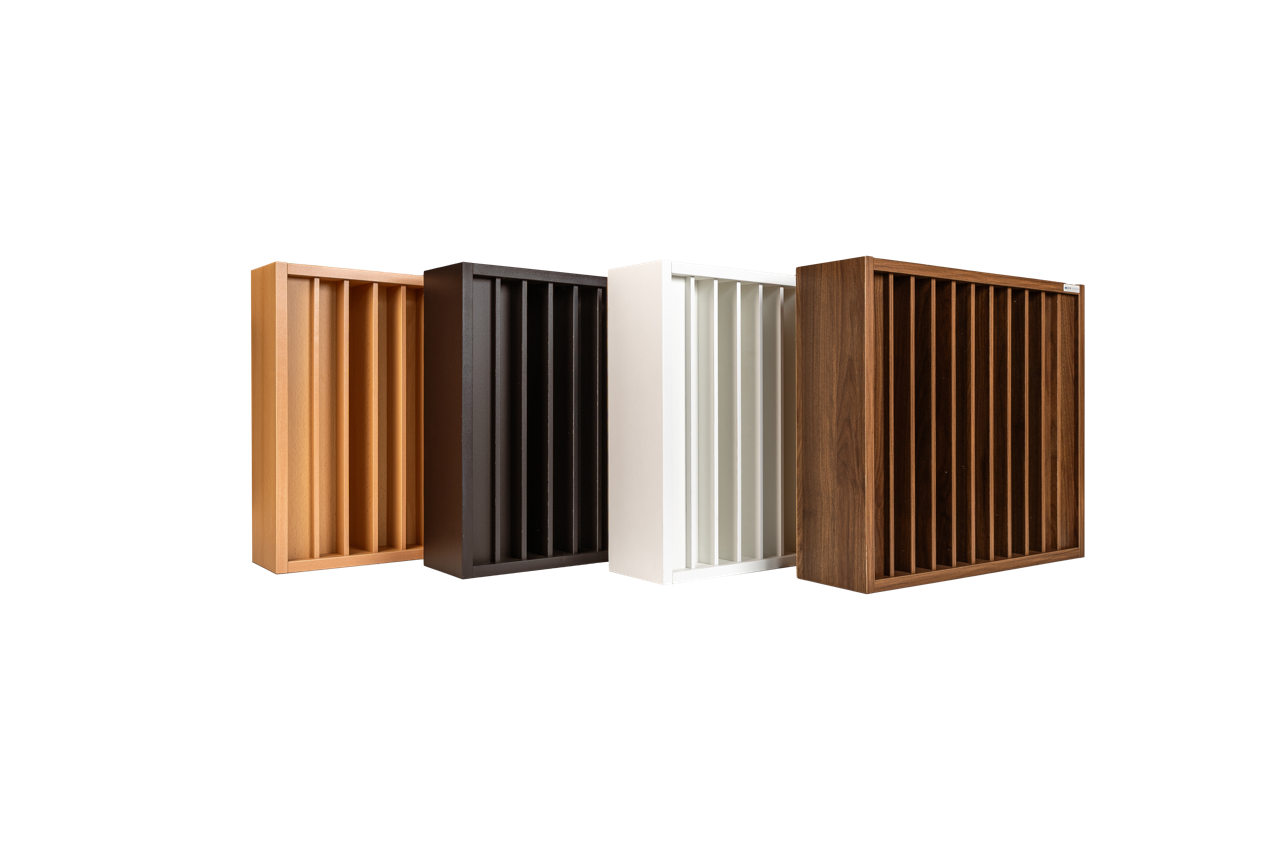
The QRD (Quadratic
Residue Diffusor) type diffusor (GIK D1) is a mathematically non-repeating
design featuring varying sized "wells" where the well width determines the
high-frequency performance and the well depth determines the low-frequency
performance. The purpose of the QRD is:
(1) evenly disperse the sound
energy back into the space (retaining similar amount of energy) and (2) diffuse
the phase content of the reflection so it does not smear (comb filter) with the
oncoming energy (varying depth = varying time= varying phase response).
The Polycylindrical
diffusor (GIK Poly) is based on a curved surface which randomly re-directs
sound energy based on the radius of curve and angle of incident of sound
energy. This type of diffusor again
retains the acoustic energy but it does not affect the phase relationship of
the energy.
In terms of frequency
response, quality QRD's are typically effective down to 400-500 Hz...which the D1
does. The effectiveness of a poly is
determined by the depth, width and radius of the curve. The GIK Poly should in fact be effective down
to the same 400-500 Hz region based on the 5" depth and the 2' width.
The cool thing about
all quality diffusors is that below the diffusion cut-off point, they yield
some amount of low frequency control (bass trapping). The GIK Poly is in fact a diaphragmatic panel
trap and should yield some nice absorption around 150 Hz.
So what does a Poly
sound like verses a QRD:
-
A poly is a
victim of peer pressure. By this, they
will sound different depending on what the neighboring surfaces are. By itself, next to hard surfaces it can be
unpleasant creating detectable pings.
But, when properly located in clusters, in relation to boundaries and/or
with absorption, they truly sound totally neutral in a most cool manner. You do immediately get a bigger feel
psychoacoustically.
-
The QRD really
holds its own sonic imprint: warm, non-directional yet sonically cohesive. A great acoustic guitar played into a single
quality QRD just feet away will sound
like an even greater version of same guitar.
-
Here is a good
analogy for the "studio types": a QRD is more like a mic pre where you select
it for its character and ability to translate the frequency response in a
desirable manner. Whereas, a Poly is
more like a microphone where you select it for its frequency response and polar
pattern. If you think about locating a
QRD or Poly in these terms you can allow your imagination to run.
Uses:
Both QRD and Poly
diffusors are one-dimensional, meaning that sound is dispersed perpendicular to
the orientation of the linear features of a QRD or in the same plane as the
radius of the Poly. Immediately you
might see how the use of clusters of units where adjacent diffusors are rotated
90 degrees is a tremendous design thought.
Using absorption in
combination with either diffusion type is how overall balance can often be
obtained. In fact, the combo use of
absorption can be essential with Poly's.
Focusing on the GIK D1
and Poly. I like the rounded edges of
the D1 that minimize edge diffraction effects.
What this means in real life is that the D1 will sound smoother at
closer distances that hard edge QRD options.
This allows the D1 to be placed in more sensitive situations (smaller
booths, or theaters). The GIK Poly is a
perfect size for lots of applications.
The 2'x2' profile allows clusters to congregate on a surface or easily
installed columns.
Applications for
Studios:
-
The "classic"
application is the rear wall of Control Room.
First, you want 8' (as a general rule) minimum from mix chair to back
wall to implement a QRD. The use of the
D1's covering 24 sq ft minimum can greatly enhance the sweet spot at mix
position: you can move more freely from side to side/forward & back and
hear consistent content in terms of mid/hi response.
-
Any large
exposed sidewall and ceiling surfaces in the rear half of a control room are
targets for diffusion. The D1 is a
better option in general, but paired with absorption, the Poly could direct
energy in very pleasing ways to the client seats.
-
Here is a
control room rear wall Poly application I recently designed for ZenProAudio.com. The given factor is that the walls are 100%
absorptive in the mid/hi bands. Thus the
Poly's became a wonderfully exciting option to retain life in the space while
not creating any detrimental acoustical glaring, smearing or other mix position
horrors. By rotating the adjacent units
that are on rear wall and rear ceiling and placing specifically sized and space
slats on rear sidewalls; Warren Dent has a mix space with great accuracy. As you might expect, the client position is a
little unbalanced (being right against the rear wall) but still comfortable and
more friendly than a totally dry listening space.
-
In a small
booth with very effective broadband panels like the GIK 244 & Monster
panels, you can place the D1 (or QRD) in a cluster on the ceiling (in rooms as
low as 8') and get a modern vibrant timbre without detrimental artifacts. The goal in "capture" or tracking phase is to
find the most exciting representation of the performance...but it has to remain
exciting with other tracks. Specular
reflections off hard flat surfaces create artifacts that only get more
problematic with other tracks and typical mix processing. Sure you can absorb such hot spots, but that
doesn't lead to excitement.
-
If you have
10' ceilings or higher the Poly becomes a leading contender for a bigger
feeling space. You would look at 10-20%
coverage of a surface to have significant impact. Spacing Poly's 6" apart minimum is absolutely
imperative in most applications. Keep in
mind that you have to look at all surface interactions in this type
application.

-
Check out the
rear wall behind drums in JR Robinson's drum room which I did treatment design. The D1's are dispersing the hot sidewalls
flanking his high frequency absorbing tapestry.
This immediately improved the tonal definition of toms and cymbals
(remember the D1 is smoothing out the mid bands very effectively) while leaving
JR the bright room he desired...a little went a long way!
-
One big tip
that can allow a little diffusion and a lot of hard "un-treated" wall to yield
great results: stagger or offset diffusors between parallel walls. I recently did an acoustic make-over of a
room (17'x18'x10') that was nearly all absorptive on the walls and had some
less effective one-dimensional diffusors on the ceiling. I re-appropriated his absorptive panels from
walls to 20% coverage of ceiling (evenly spread), and other than very select absorption
zones, used a quality QRD type diffusor to clean up hot spots on the vertical
walls. We also added a bamboo floor and
placed the lesser effective diffusors surrounding window. We created a very cohesive, bright , yet
controlled tracking room just by locating diffusion on the walls in relation to
each other and accounting for the manner that sound would propagate in the
room.
-
TABOO TOPIC...diffusion
above mix position. Yes it's true and is
now in print for others to read. I have
successfully applied QRD style diffusors above mix position and increased the
ability to determine spatial and depth decisions...lock in on attack/release
compressor settings, combine reverb and panning elements. It is not a "one size fits all" application
BUT it can work especially if the mix engineer has a greater sensitivity to
vertical reflections.
Applications for
Theaters
-
Depends,
depends, depends...speaker type, speaker location, proximity of seats to
boundaries...but:
-
The rear third
of most residential theaters is prime for diffusion. Most application use Bi-Polar surrounds and
diffusing this energy truly does yield a more cinema like response: you hear
the surround information, can track it during dramatic panning situations, but
like a good commercial theater you never become aware of surround speaker
locations.
-
If you have a
ceiling 10'-14' you can use diffusion on the ceiling to mimic the large room
yet intimate feel of a commercial cinema.
-
As most THX
style center channel speakers are designed to have very polite vertical polar
response, you can use QRD style diffusors on the halfway point between speaker
and seats to yield a more intimate theater response: tying the audio and video
together wonderfully. This can be done
in lower rooms and even rooms with vault profiles. Alternating diffusion and
absorption panels on such vault angles can yield a more even response from seat
to seat than just absorption panels.
-
If you have
more than 6' distance from boundary to nearest seat, then sidewall columns of
Poly's could work wonders! Not that
"tighter" applications wouldn't ever be possible, but you would have to be
concerned about glaring and smearing with the direct sound.
OK, the above is long-winded,
has some purely technical, some anecdotal and some true & successful
diffusion applications...BUT I trust the article
is helpful and I want to extend my greatest appreciation of GIK for their
off-the-charts value driven product line and true desire to help their
customers enjoy great audio!
By Jeff Hedback
|
Bio Jeff Hedback of Hedback designed Acoustics LLC.
|
Hedback Designed Acoustics is a niche-based acoustical design firm
focused on Pro Studios, Performance Driven Residential A/V & Small-Format
Commercial Projects. Every space has a
unique story to tell where "Imagination intersects Physics", "Innovation yields
Performance" & "Aesthetics create Accuracy". Select clients include the band Lifehouse,
Cabo Wabo Radio, and the Bixby, OK Spirit Band Center. 
Jeff Hedback graduated Cum
Laude from Berklee College of Music ('87) majoring in Music Production and Engineering
with a minor in bass performance. He
spent seven years at a major acoustics manufacturer design treatments for
various levels of studios, theaters and commercial spaces. Jeff was awarded a US Patent for being the
primary developer of the Auralex GRAMMA speaker isolation riser. This product
is found worldwide under guitar amps, bass rigs and home theater subwoofers. As
a musician, session/touring bass player, Jeff has credits on several national
releases (Arista Records, CBS Records, Rounder/Philo Records). He has performed
as a headliner, support act, and background chatter in all types of spaces; the
largest stadiums, worship spaces, and smokiest clubs. To this day he continues
to study, practice and get inspired by all things that are
bass.
www.HedbackDesignedAcoustics.com PH: 317-863-0753
|
|
|
Bringing Your Sound to Life.
Sincerely,
|
|
Glenn Kuras
GIK Acoustics
|
|
|
|
|
|
 |
 |
 |
 |
|
|