


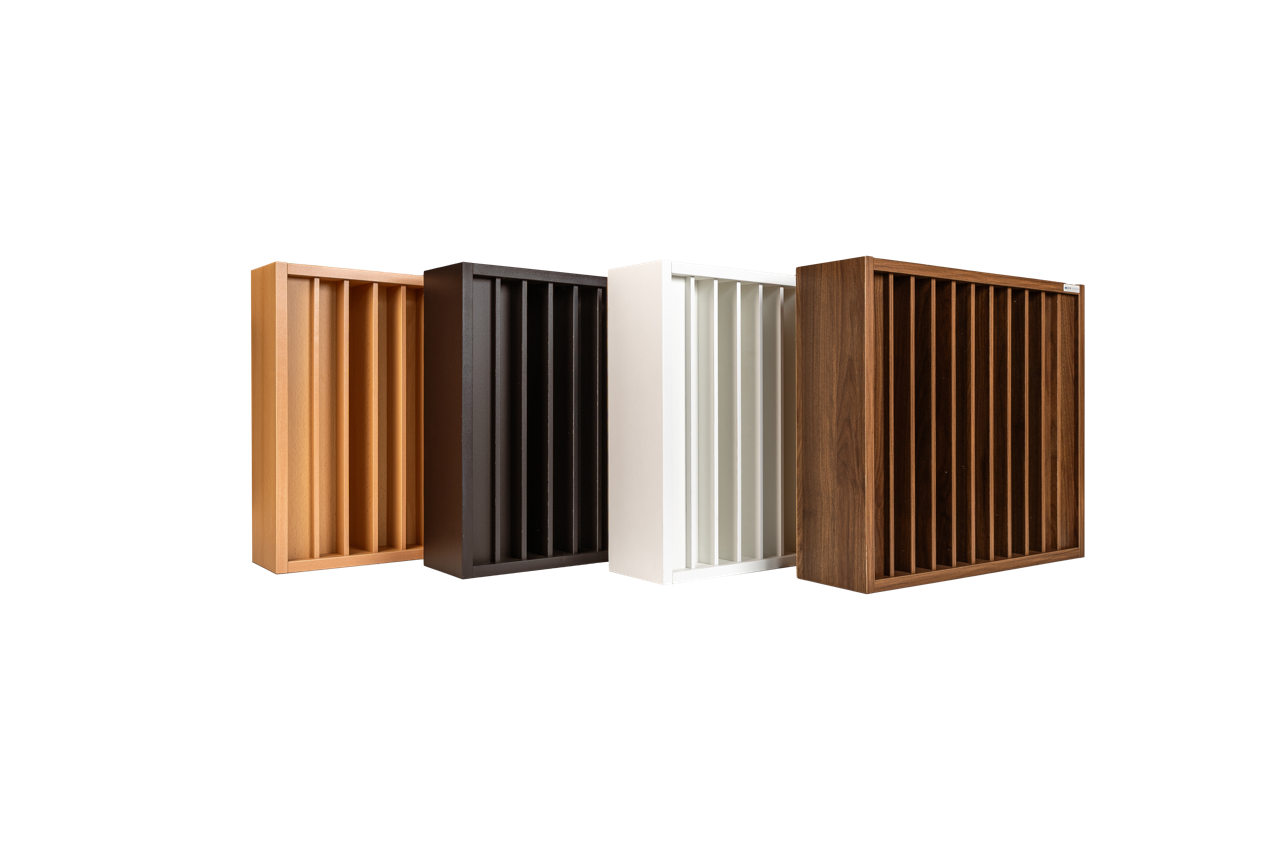
Many people misunderstand diffusion and its applications. For GIK, diffusers are the go-to product category to take an already-good room to the next level.
In rooms like this, the most fundamental and severe problems have been addressed. The early reflections are controlled. Bass decay is mostly in line. Clarity improves, mix translation improves for audio pros, and the room finally stops fighting you. But when we only use absorption, the sound can be unbalanced. The space sounds better but feels more claustrophobic than it should. The room sounds controlled, but it stops giving useful spatial information back when you spend time in the room. Spending long hours in a room like this, while far less fatiguing than an untreated room, can still feel limiting and artificial.
That is the context in which Q11D exists. To take good rooms like this to the next level and make them great.
Why Q11D?

Over years of designing studios, control rooms, and listening spaces, we kept running into the same moment. Once decay times are under control, continuing to add only absorption often produces diminishing returns. Because high-frequency absorption is, in general, more efficient than bass absorption, the treble disappears faster than the bass, and the room starts to feel unnaturally dry and sterile.
At that stage, like all stages in room acoustics, it's all about time behavior. Specifically, what happens to sound energy after the first arrivals. Are decay times more or less even across the spectrum? Or are the treble decay times a bit too short?
Q11D exists to address these balance problems directly. It allows late-arriving energy to remain in the room, but reshaped in a way that supports depth, width, and spatial clarity rather than comb filteriing, harshness, or listening fatigue.
Q11D Solutions
Q11D is most effective in rooms that are already well controlled and need help preserving spatial information rather than deadening reflections. A common example is the rear wall of a listening room or control room, where reflections arrive later in time and play a major role in perceived depth and envelopment. Absorbing all of that energy often makes the room feel smaller and claustrophobic, even if clarity improves. In this position, Q11D reshapes that late energy so it contributes to width and depth without interfering with imaging or timing cues.
Another scenario where Q11D performs particularly well is on the front wall of a listening room using dipole speakers. Dipoles intentionally radiate significant energy backward toward the front wall, and that reflected energy becomes part of the listening experience. Fully absorbing it can undermine the speaker’s intended presentation, while leaving it untreated can introduce comb filtering and smear. Q11D allows that energy to remain in the room but distributes it in a controlled way, supporting a stable soundstage while reducing destructive interference.
Q11D is also a strong fit in live recording rooms with acoustic instruments, where preserving a sense of space is part of the instrument's sound itself. In these environments, the goal is not maximum deadness but controlled liveliness. Diffusion helps maintain natural ambience and dimensionality while preventing strong reflections from dominating microphones or creating uneven room tone. When used alongside appropriate absorption, Q11D helps strike that balance, keeping the room expressive without becoming unpredictable.
Why One-Dimensional Diffusion Matters in Real Rooms
 In real rooms, not theoretical ones, diffusion needs to be predictable.
One-dimensional quadratic diffusion focuses on lateral energy redistribution. That matters because most rooms already have vertical constraints. Ceiling height, speaker geometry, and ceiling-mounted treatment all limit how much vertical scattering is desirable.
By diffusing sound horizontally (left/right, assuming normal vertical mounting), one-dimensional diffusers preserve width and spatial stability without introducing vertical artifacts that can interfere with imaging or clarity.
One-dimensional diffusion is also inherently more efficient than two-dimensional diffusion, producing more total diffusion even though it's only across the one plane.
This makes one-dimensional diffusion especially effective on rear walls and in the back halves of rooms, where reflections arrive later in time and should be shaped rather than eliminated. The Q11D was designed with those realities in mind.
When Diffusion Makes Sense (and When It Doesn’t)
Diffusion is not a shortcut. If early reflections are still strong or bass decay is uncontrolled, absorption should come first.
Diffusion becomes meaningful only once the room’s decay behavior is already in a reasonable range. At that point, it is no longer about reducing sound. It is about shaping it.
For a deeper, accessible explanation of this balance, we recommend starting with these articles:
Both walk through how absorption and diffusion work together in real rooms, not just on paper.
Industry Coverage Highlights
The Q11D launch was covered across pro audio and installation press, with each outlet focusing on its role within complete room designs. You can read details for the press coverage in the Q11D Industry Reviews & Coverage article.
Where to Go Next
If you want to explore technical details and configuration options, you can Explore Q11D on the product page.
If you’re unsure whether diffusion is the right move for your room, that uncertainty is healthy. The best next step is to learn when diffusion is right, starting with the resources above.
And if you want guidance specific to your space, the most effective place to begin is GIK’s Free Acoustics Consultation. Submit the Acoustic Advice Form with your room details and goals, and our design team will help you determine whether diffusion, absorption, or a combination makes the most sense.
That way, Q11D becomes a deliberate refinement, not an assumption.



Share:
Amplitude Makes Waves: GIK Acoustics Blends Design with Performance
GIK Acoustics PIB Vocal Booth Pro Reviewed by Sound On Sound